Sandpile: one grain at a time, until everything is avalanches
Drop grains of sand one by one onto a flat table. Each pile grows steeper until it cannot: the next grain starts a slide. For a while the slides are small. Then, without any change to the rules, the pile settles into a state where a grain can end the run quietly — or send a cascade through the entire table. There is no tuning knob, no target slope, no parameter that decides this. Below: a pile built grain by grain, two avalanches from the same pile played frame by frame, and the numbers that say the chaos has exponents.
The pile, from one point
I drop every grain on the single centre cell of a 600×600 table (the more common version, a grain at a random site, gives the same exponents). Sand that exceeds the threshold of 4 topples: it loses 4 grains and hands one to each of its four neighbours. A toppling can push a neighbour over 4, which topples in turn: that is an avalanche. The rule is abelian — the order of topplings never changes the final pile — so the whole cascade can be processed in any order, which is what makes a few billion topplings possible on a laptop.
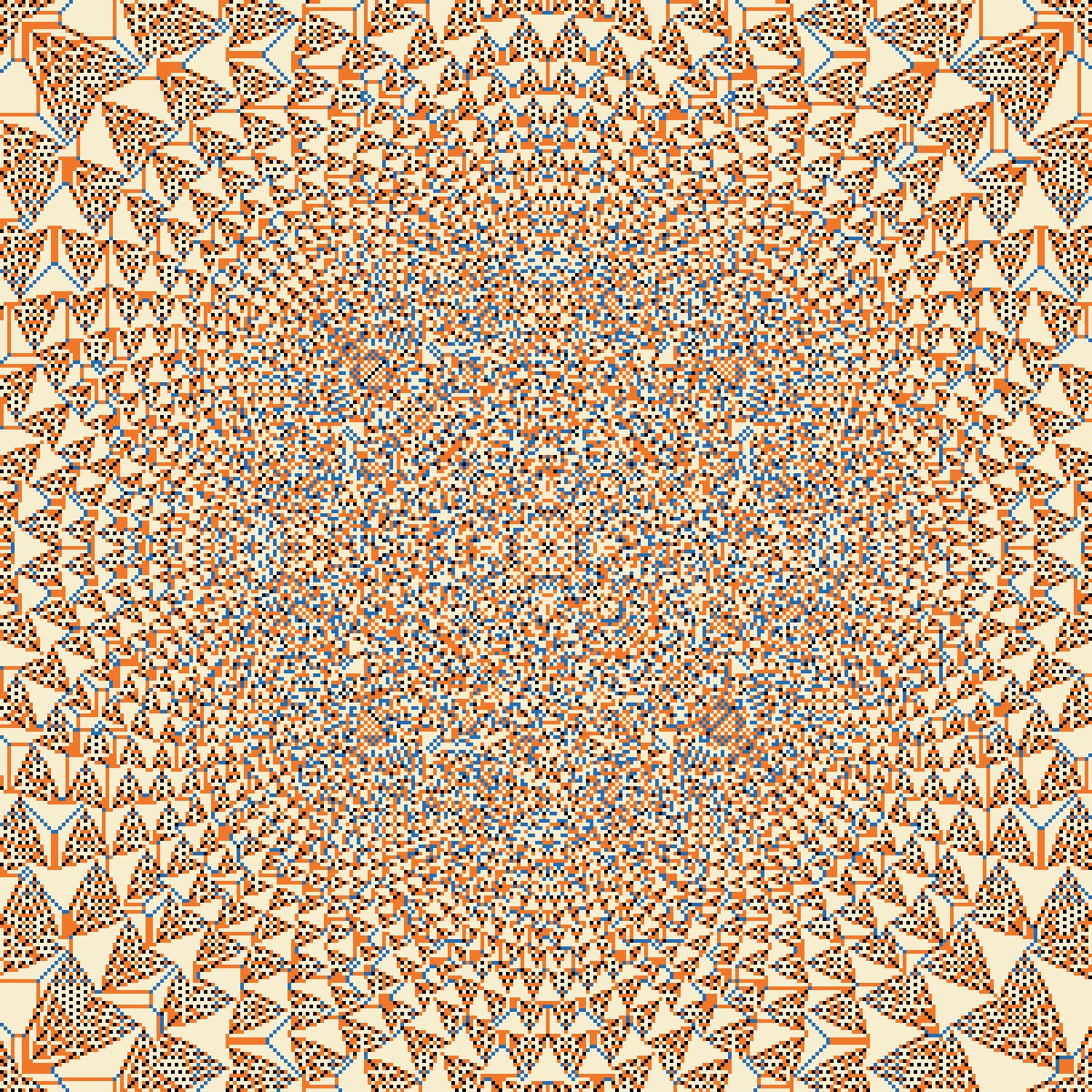
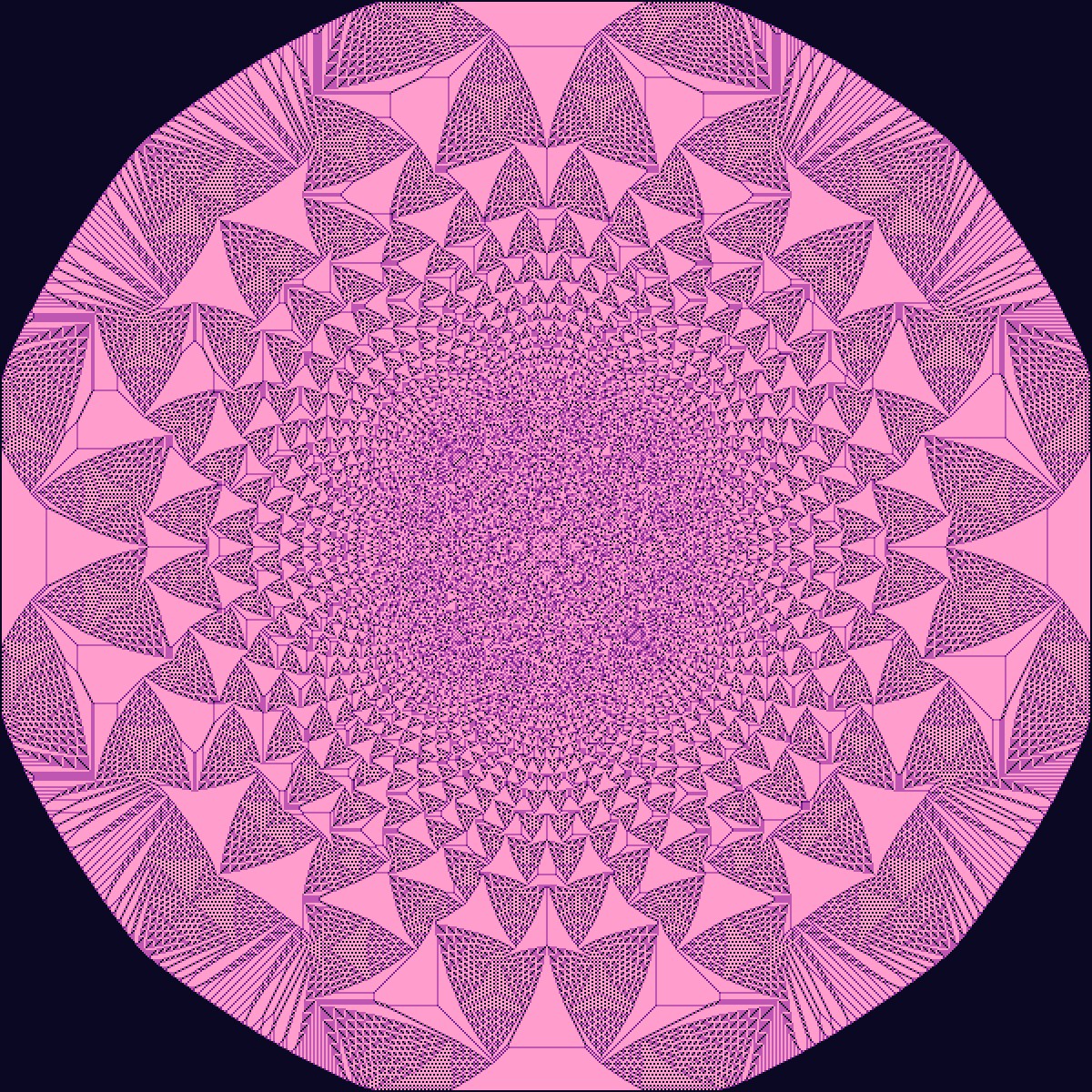
The image is height mod 4. Cells with 0 grains are black, 1 dark blue, 2 mid, 3 light, and the pattern of 0/1/2/3 layers tiles the table in a self-similar checkerboard: squares inside squares inside squares, down to the pixel. That texture is the critical state; it looks the same after 200 000 grains as after 1 400 000.
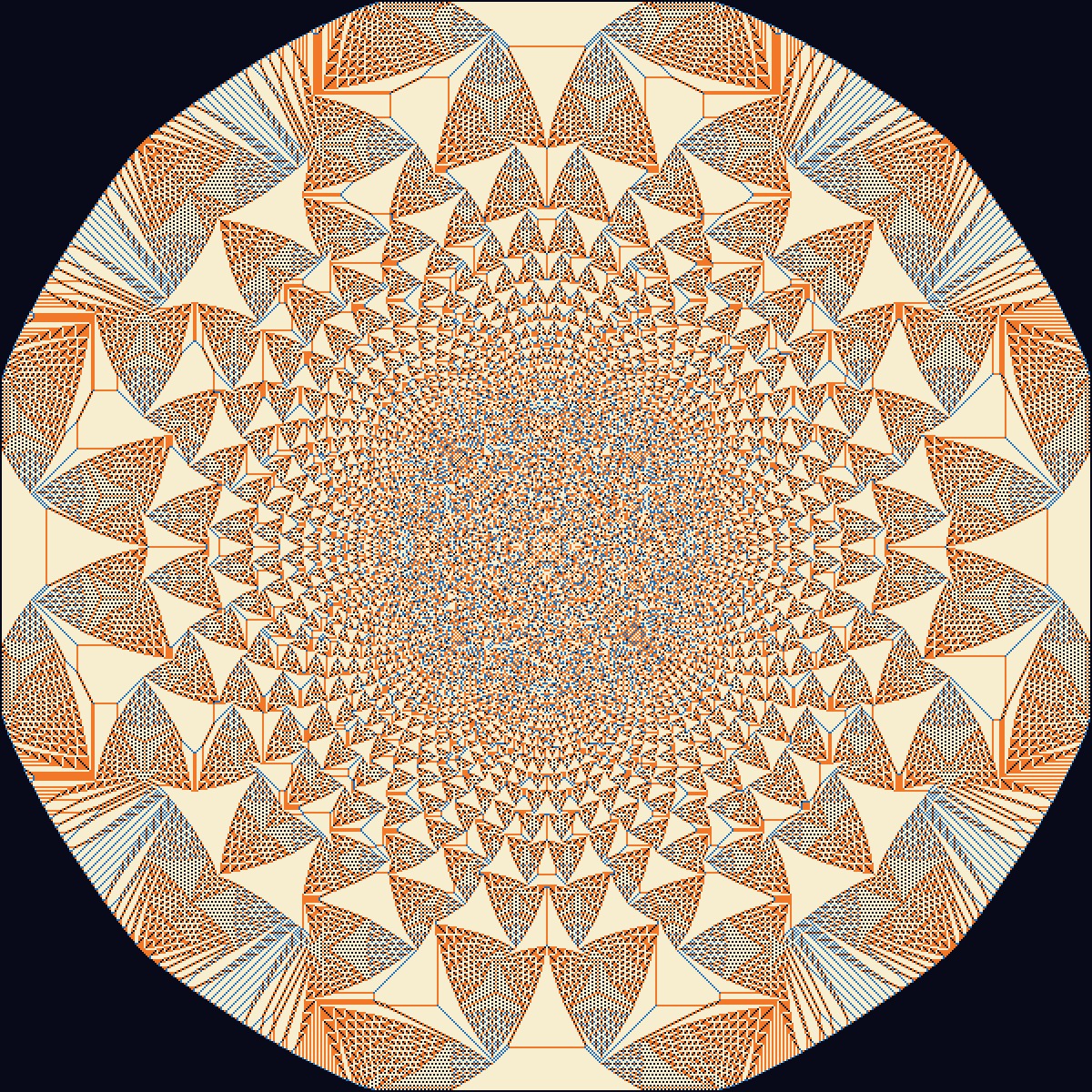
A 600×600 pile after 1.4 million grains, every grain dropped on the centre cell, doubled in size. Mean height 4.0 grains/cell; the pattern is the residual of every avalanche that ever happened, written in layers of four.
Two avalanches, frame by frame
Recorded from a 256×256 pile after it had settled. Each frame is one parallel generation of topplings: everything over threshold falls at once, so the bright front is the set of cells that gave way together. Hot colours = how far above threshold a cell is; the pink tail is cells still warm from the front passing through them. The first is 2 572 topplings over 108 generations; the second is 5 124 topplings over 136 — and both are ordinary, not rare.
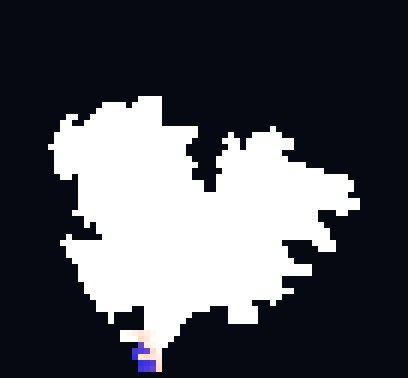
2 572 topplings, 108 generations. The avalanche starts as one cell over threshold and spends most of its life as a thin wandering front, not a symmetric ring.
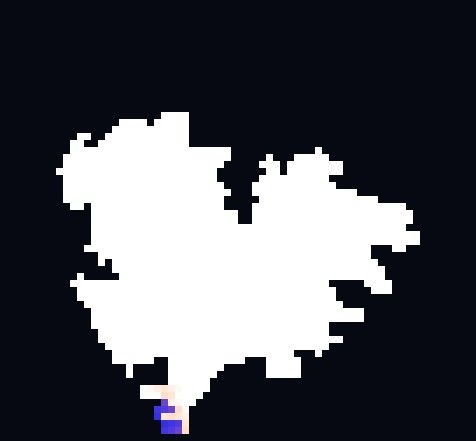
5 124 topplings, 136 generations, from the same pile 7 grains later. Roughly twice the size, from the same rules: the sizes are spread over everything.
The exponents
For every avalanche I record its size s (number of topplings), its area a (distinct cells touched) and its duration d (generations). Each has a probability that falls as a power of its size: P(s) ∝ s−τ. Fitted by maximum likelihood, the exponent comes out near 1.26 for the size — the published 2D value for this universality class is 1.2598. A pile of 256×256 holds about 105 grains and its avalanches run up to 3.7 million topplings, so the cutoff you see bending the curves over is the finite table, not the model.
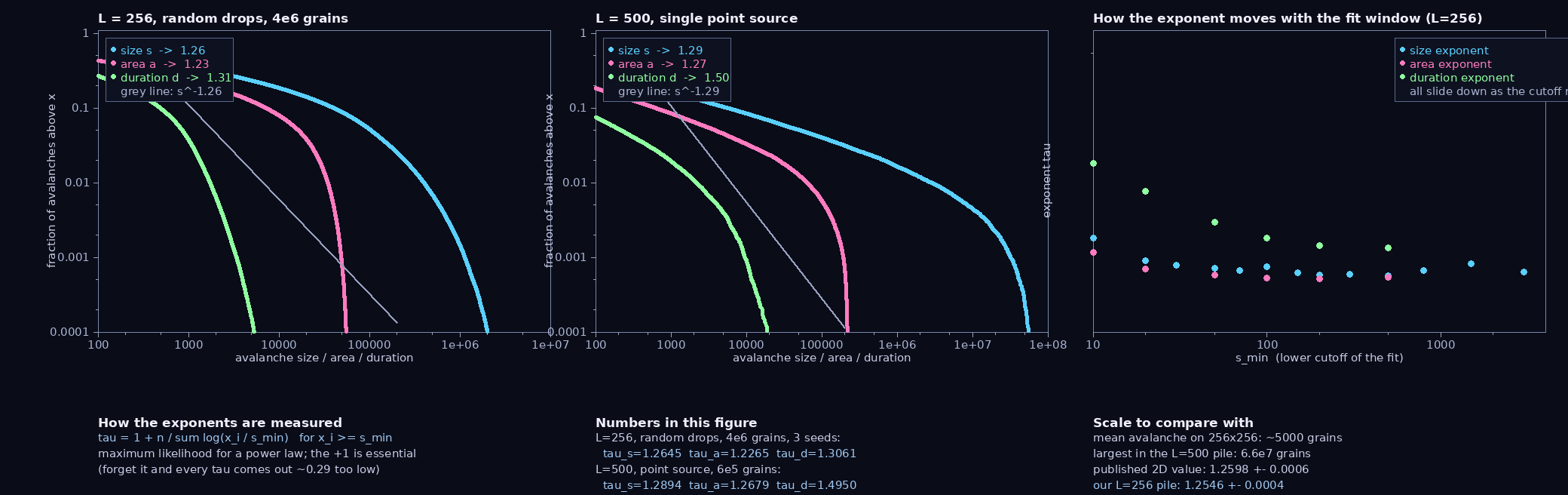
Left: complementary cumulative distributions from 4 million grains at three seeds — straight lines across four decades. Middle: the same from a 500×500 point-source pile. Right: how the fitted exponent moves as I raise the lower cutoff of the fit; all three exponents slide down together as the finite-size cutoff is approached.
Notes from building it
- The crash that taught me about queues. My first version toppled
cells out of a plain queue and segfaulted within seconds: a cell that topples while
already queued overflows the buffer. The fix is the ring: a cell can only be in the
queue once, because a toppling leaves it below threshold, so a queue of
L×Lentries is provably enough. That abelian property is also why parallel and serial toppling give identical piles. - The +1 in the estimator. The maximum-likelihood exponent for a
power law is
1 + n / ∑ log(xi/xmin). I dropped the 1 and every exponent came out near 0.29, which looked "plausible" for one embarrassing hour. Fitted on the same data: 1.2645. - Windows matter more than grains. At L=64 the fit gives τ≈1.47; at L=256 with 4 million grains it gives 1.2546. Small tables overestimate the exponent because large avalanches simply do not fit. Fitting up to 1015 is harmless: nothing is that big, the tail is empty.
- Point source is the money shot. Dropping on one cell builds a cone and a much cleaner self-similar texture than dropping at random sites, and the exponents are the same (1.289 vs 1.255, finite-size shift). Point source is also slower per grain: every avalanche is huge.
- Costs. L=500 with 600 000 grains: 6.1 billion topplings, 154 501 avalanches, the largest taking 66 million topplings — 11 minutes of one core. L=1024 never finished, so the figure stops at 500. Built with AddressSanitizer turned on for the final runs; the L=900 experiments died of RAM, not bugs.
- mod 4 is not a trick. I render height modulo 4 because the dynamics are mod 4: a cell at height 5 is one grain on top of a cell at height 1. The texture the eye sees in the hero image is the same quantity the toppling rule reads.
back to the lab ·
source: ~/src/sand.c